
Count Lev Nikolayevich Tolstoy, AKA Leo Tolstoy, AKA The Count (1828-1910)
Penguin Books UK, Edition First Published 1954 and Translated into English from the Russian by Rosemary Edmonds.
Classic Russian Literature. Literary Genre: Realism. First published by Tolstoy in 1875-77
WARNING: SPOILERS ABOUND BELOW….
Told from the point of view of several very prominent and interwoven Russian families, the story is set in 1870s Russia; moving between Moscow, Saint Petersburg and the Russian countryside. The characters seem to walk unawares along a knife edge formed by the collision of the traditional with the modern. As the story unfolds the fruits of these divergent world-views appear.
Novels of a similar genre, led me to expect AK to be difficult reading, containing lots of long names, which are too similar (or in some cases identical!) to the names of other characters – see Dr. Zhivago or worse; Wuthering heights. However this was not so with AK. The translator Rosemary Edmonds: “For the sake of clarity I have used the surname wherever possible” – thus avoiding the confusing three-fold naming system used in Russia. This left room for a clearer mind to absorb the well described scenery. The Count develops his characters well; masterfully linking their inner and outer worlds with rich and entertaining dialogue. This idea of linking inner and outer, worked as a subtext through the story and gave me a hint about the main thrust of the novel. The only negative about the writing style (ALERT! Grammar rant pending) was that the translation into English often produced the phrase ‘try and’ [not ‘try to’ or ‘try for’]. I don’t quite know why but it bugs me so much, please let me know your thoughts.
Many concepts are embroidered over the nankeen§ of this novel. In fact, I think all Dewey categories are covered in the lofty conversations, internal monologues and character development. So there is sure to be much for the non-fiction lover also. As I hinted at earlier, I think the main theme is the unfolding of the world-views of the main characters…
The eponymous character sees love as a spontaneous desire: “.. love does not come at will: there’s no forcing it.” (Anna, p. 731)…
The biblical Christian view is of love as a choice…
“Do not waste time (says C.S. Lewis) bothering whether you ‘love’ your neighbour; act as if you did. As soon as we do this we find one of the great secrets. When you are behaving as if you loved someone, you will presently come to love him. If you injure someone you dislike, you will find yourself disliking him more.” (C.S. Lewis in Keller & Keller, 2015, p.100, from a WWII radio Interview)¥
Levin, one of the main characters, begins the story immersed in a traditional culture and like Anna, Levin also felt angst at the dissonance of his world with his worldview, however he persevered with the traditional way of living. Anna however, fled the tension and gradually threw it away. Levin was a bachelor at the beginning of the story and desired the traditional family and marriage, whereas Anna was unhappily married and hence traditional culture was against her outer life and for Levin’s. When Levin is most helpless, to his own surprise he automatically prays and seeks God’s help and mercy. His closeness with the earth as a farm owner, the reality of death and the simple faith of the peasants who work for him, suggest to him that his modern worldview is not only contradictory to his desire for a meaningful life; it does not line up with the way things actually work. As Anna aligns her outer world with her inner world, leaving her husband and son; Levin strives to align his inner world with the outer: they are both becoming congruent, but to opposing world-views. As Levin matures away from his bachelor naïveté, we see him humbly align himself with the world around him. Anna seeks the opposite, desiring to change or deny the world to suit her own desire. Levin learned to see himself as the outlier and adjusted accordingly. It was perhaps easier for Levin, because he actually desired what tradition and culture encouraged, despite his initial mental dissonance against it.
This mighty novel left me with a reminder that the Christian view of marriage is revealed to us and does not come from within the human system – and that is why we don’t like it; because it does constrain us – not to enslave us, but to free us from the destructiveness and chaos of pursuing only what we want for ourselves until we surely lose even that… “Whoever tries to keep their life will lose it, and whoever loses their life will preserve it.” (Luke 17:33). It’s interesting to note at this point that research reveals that people who are married are consistently more satisfied than those who choose alternatives such as cohabitation and further; that those who are not happy, eventually become so if they persevere and remain married (ibid, p. 26 citing two separate US reports).¥¥
The fact that this book is 853 dense pages long and I got through it speaks to me of its quality. I zoomed through sections of it, lost track of time and felt transported to a world of horse-drawn sled trips to the Opera. It is such a great read and is full of insight into marriage, faith and the value of commitment.
Highly recommended: 4.5 stars
ǂ My edition is Called Anna Karenin; a decision of the editor. For simplicity the surnames of married women are written in the masculine [no ina] to avoid confusion and to more accurately translate to western norms.
§Nankeen – wikipedia link. A coat, a colour a kestrel! – only the coat features in the novel.
¥¥ In the instance of abusive and violent relationships perseverance may be unhelpful. If you are in such a relationship, please see my resources page and/or make contact with one of the support services in your area.
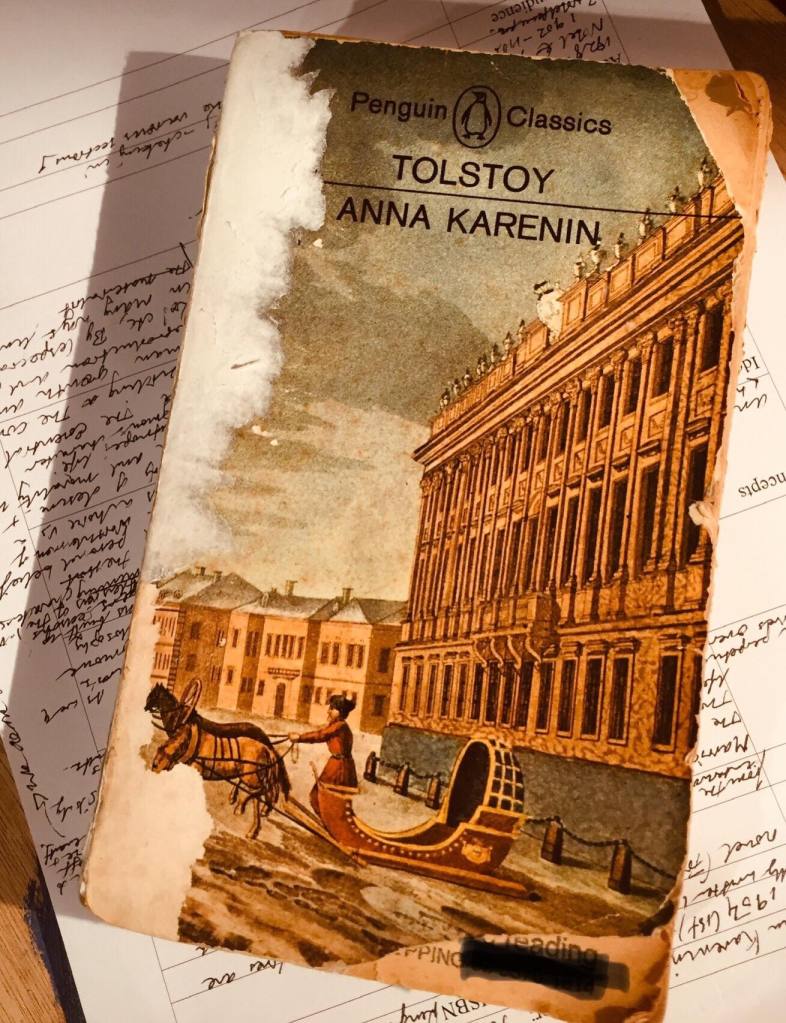
ǂ see note
 Stan Winn, Counsellor