Nemo Resideo
No Comrade Left Behind
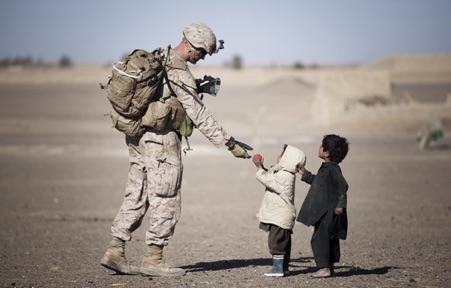
Imagine for a moment that you are a part of an army going off to protect a city from invasion by hostile forces. Your commanding officer gives the briefing: it’s going to be tough and lives may be lost. There will be danger at every turn, co-operation is vital and capture by the enemy a constant threat! Now imagine you are lined up ready to get in to the helicopter alongside all of your comrades and your commander says, ‘Right you know the risks, don’t expect us to come and get you if you’re injured or captured, sign the waiver and get on board!’ What would you feel like doing at that moment? I know right, me too. Guess what? You’re not alone. The concept of nemo resideo, or “leave no one behind,” is very old. Most elite military units have enshrined this into a creed or motto. Examples include the Marine Corps, The Airman’s Creed [USAF] and The US Rangers who vow: “I will never leave a fallen comrade to fall into the hands of the enemy.” (See Galdorisi, 2014) The military knows that a soldier, though very brave already, will take bigger risks and undertake much greater adventures if someone ‘has their back’ and if they know that they matter to their country and their fellow soldiers.
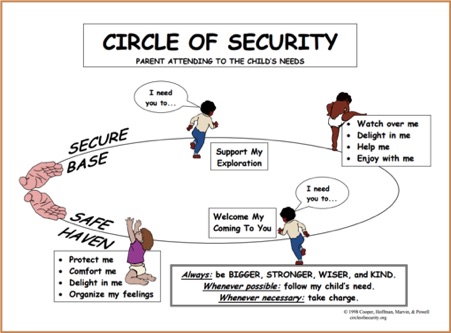
In psychological terms, this concept is known as Attachment and has been very well explained in the picture above – The Circle of Security (COS) (Powell et al, 2009). Children and Marines need both a safe base – from which to launch out and explore and a safe haven – to return to in case of danger. If either is missing or uncertain, children will become anxious – which is a normal and natural response. As parents, carers and adults it’s our job to be bigger, wiser and stronger and not to worry if our child is worried or anxious – that’s normal – but to try to remain calm so we can comfort, encourage and then support more adventures! This is a great reminder for me both personally and professionally. I know I wouldn’t be able to do what I do every day either without the support of my darling wife for example, who encourages me and gives me a safe place to come home to. Our kids need this much more than you or I and it’s our job to provide it for them (Johnco Carly, et al, 2022). Later when they grow up to be adults, they will have ‘internalised’ this circle of security within them and so be able to offer it to others around them, including hopefully their own dear family. There is much research to show that when children don’t have that Circle of Security they can really struggle (Bikic et al, 2022) and this shows up in behavioural issues, anxiety and externalising/internalising symptoms (Moss et. al., 1998). I sometimes think that going to school for the first time might feel a bit like going in to battle! If children know you’ve got their back and love them unconditionally – they’ll be much stronger and braver for it! Huber et. al., (2016) show that parenting using the Circle of Security reduces the stress for the parents too! Try not to be anxious if your child is anxious, be bigger, wiser and stronger. When kids are anxious it often just means they need to come back to base camp and check in – get some reassurance and unconditional acceptance and then off they’ll go on up the mountain! I hope this was helpful… “nemo resideo!”
~Stan Winn
Bikic, Aida, et al. “Protocol for a randomized controlled trial comparing the Circle of Security-parenting (COS-P) with treatment as usual in child mental health services.” PLoS ONE, vol. 17, no. 4, 26 Apr. 2022, p. e0265676. Gale Academic OneFile, link.gale.com/apps/doc/A701662404/AONE?u=slnsw_public&sid=bookmark-AONE&xid=3464a2d1. Accessed 31 Oct. 2022.
Capt. George Galdorisi, June 2014. CNN Opinion Piece. https://edition.cnn.com/2014/06/09/opinion/galdorisi-leave-no-man-behind/index.html
Huber, Anna, et al. “Improved Parental Emotional Functioning After Circle of Security 20-Week Parent–Child Relationship Intervention.” Journal of Child and Family Studies, vol. 25, no. 8, 2016, pp. 2526–2540
Johnco Carly, et al. “The Role of Parental Beliefs About Anxiety and Attachment on Parental Accommodation of Child Anxiety.” Journal of Abnormal Child Psychology, vol. 50, no. 1, 2022, pp. 51–62.
Moss, Ellen, et al. “Correlates of Attachment at School Age: Maternal Reported Stress, Mother-Child Interaction, and Behavior Problems.” Child Development, vol. 69, no. 5, 1998, pp. 1390–1405.
Powell, B., Cooper, G., Hoffman, K., & Marvin, R. S. (2009). The circle of security. In C. H. Zeanah, Jr. (Ed.), Handbook of infant mental health (pp. 450–467). The Guilford Press.
Soldier and Children [Second Image] from Public Domain [Wikipedia].


 Stan Winn, Counsellor